Bring Your Grandmother's Recipe: The SF Restaurants Turning Diners' Stories into Dinner
The card showed up on a Tuesday, tucked inside a thank-you note from a regular. It was handwritten in faded ink, the paper soft at the folds from decades of handling, and it described a Filipino pork adobo that the customer's lola had made every Sunday for as long as anyone in the family could remember. There was no precise measurement for the vinegar. The garlic was listed simply as "enough."
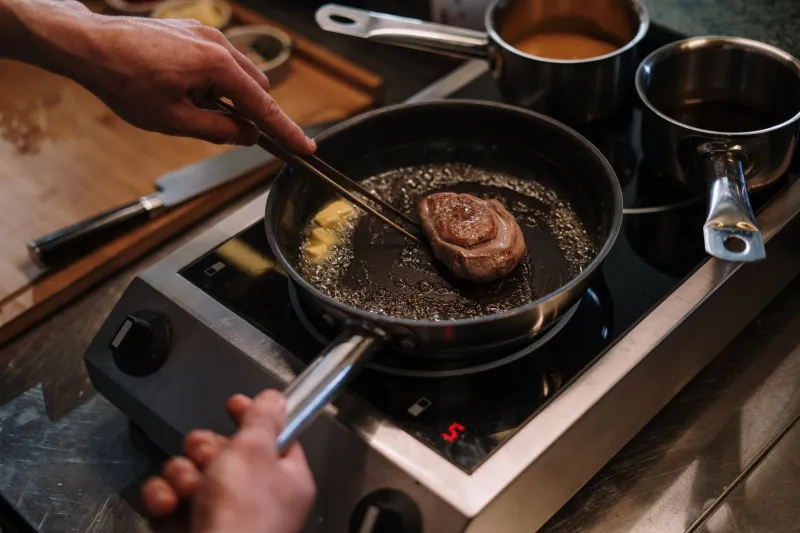
The chef who received it, Dominique Faure of a small French-Californian bistro in the Richmond, spent two weeks thinking about what to do with it. Then she made a dish: braised pork belly with a reduction built on cane vinegar and bay leaf, served with a French-style potato gratin and a spoonful of the adobo's cooking liquid as a jus. It went on the menu as a weekend special. It sold out every time.
"That dish didn't come from me," Faure says. "It came from a family. I just translated it."
A Menu That Belongs to the Neighborhood
What Faure stumbled into with that handwritten card has since become an intentional program at her restaurant — and she's not alone. Across San Francisco, a small but growing number of French-inspired restaurants are formalizing what might be called a recipe exchange: an open invitation for diners to submit family dishes, personal recipes, or food memories that the kitchen then reinterprets through its own culinary lens.
The concept sits at an interesting intersection of community engagement, culinary collaboration, and the kind of storytelling that restaurants are increasingly expected to do in an era when diners want to know not just what they're eating, but why it matters.
For French-inspired kitchens specifically, the approach opens up creative territory that might otherwise feel out of reach. French technique is extraordinarily versatile — it's a language, really, more than a cuisine — and applying it to the flavors and traditions of San Francisco's extraordinarily diverse population produces results that feel both disciplined and alive.
How It Actually Works
The mechanics vary from restaurant to restaurant, but the general shape is consistent. Customers submit recipes through a card at the host stand, a form on the restaurant's website, or increasingly via a dedicated email address that the kitchen monitors. Some places run seasonal calls — a summer solicitation for recipes tied to warm-weather eating, a winter round focused on comfort food — while others accept submissions on a rolling basis.
Chefs then review the submissions not as recipes to replicate, but as starting points. The goal isn't to reproduce the original dish exactly — that would be both presumptuous and, in many cases, impossible given the difference in kitchen scale and equipment. The goal is to honor the dish's spirit while bringing it into conversation with French technique.
"I look for the emotional core of a recipe," says Laurent Chau, chef at a Noe Valley spot that has been running a community recipe program for about eighteen months. "What is this dish actually about? Is it about fat and warmth? Is it about acidity cutting through something heavy? Once I understand that, I can translate it."
Chau's most successful translation to date started with a recipe submitted by a Cantonese-American regular: a simple steamed egg custard that the customer remembered eating as a child. Chau turned it into a French-style oeufs en cocotte variation, baked in individual ramekins with a dash of soy and a few drops of sesame oil folded into the cream, topped with a tiny mound of trout roe. The dish was delicate, slightly savory, and completely unlike anything else on the menu. It became a signature.
The Stories Behind the Submissions
What these chefs will tell you, almost universally, is that the recipes themselves are only half the point. The other half is what comes with them.
"People don't just send a list of ingredients," Faure says. "They send paragraphs. They tell you about their grandmother's kitchen, about the smell of the house on Sunday mornings, about the argument they had with their cousin about whether the recipe uses bay leaves or not. That context is everything."
San Francisco's demographic richness makes this particularly potent. In a single week, Chau might receive a recipe from a second-generation Vietnamese family in the Tenderloin, a Salvadoran grandmother in the Excelsior, a Jewish deli enthusiast from the Sunset, and a fourth-generation Italian-American from North Beach. Each submission carries a distinct cultural logic, a set of flavor priorities, and a history that the kitchen gets to briefly inhabit.
The French technique functions, in this context, less as an imposition and more as a common grammar — a shared structure that allows wildly different culinary traditions to speak to each other across a single menu.
What the Diners Get Out of It
For the customers who submit recipes, the payoff is something that goes beyond just seeing their dish on a menu. There's a particular kind of recognition that comes from watching a professional kitchen take your family's food seriously — from understanding that the thing your grandmother made in a cramped apartment kitchen is worth the attention of someone who trained in Lyon.
"It's validating in a way that's hard to explain," says one regular who submitted a recipe for a Oaxacan mole that her mother brought to San Francisco in the 1990s. "My mom's cooking was always just our food, you know? Seeing it on a menu — even in a different form — made it feel like it was part of something bigger."
For the restaurant, the benefits are equally real. A community recipe program generates genuine word-of-mouth, creates an ongoing reason for regulars to stay engaged, and produces a menu that evolves in response to the actual neighborhood rather than just the chef's imagination.
It also, not incidentally, tends to produce very good food. The recipes that people submit with the most love tend to be the ones that have been refined over generations, adjusted and improved through the kind of iterative cooking that no culinary school can replicate.
The Line Between Collaboration and Appropriation
Not every chef who has explored this idea has done so without friction, and it's worth acknowledging the complexity. When a French-trained chef takes a recipe from a marginalized culinary tradition and reinterprets it through a European lens, there are legitimate questions about credit, context, and whose story is ultimately being told.
The chefs who are doing this well are the ones who are transparent about it — who credit the contributor on the menu, who tell the full story to guests, and who approach the source material with humility rather than ownership.
"I always say the dish belongs to the family," Chau says. "I'm just the translator. And I try to make sure that's clear to everyone who orders it."
It's an imperfect process, and probably always will be. But in a city as layered and contested as San Francisco, the attempt to cook across cultures with that kind of honesty feels like something worth doing — one handwritten recipe card at a time.