Croissant vs. Cold Brew: The Morning Battle SF Didn't Know It Needed
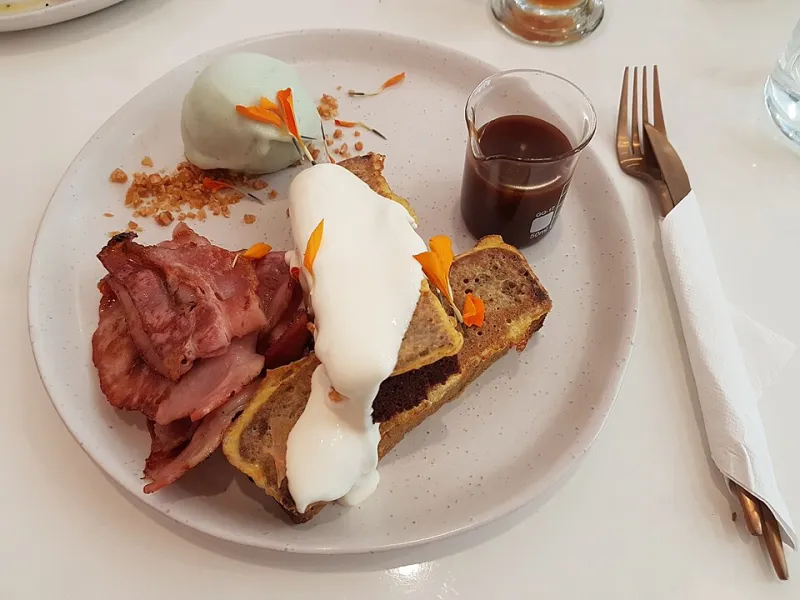
Photo: Misao_chan3, CC BY 4.0, via Wikimedia Commons
For a long time, the San Francisco morning ritual looked something like this: wake up, get to the coffee shop, order something with oat milk and a flavor shot, grab a sad granola bar from the counter display, and eat it while speed-walking to the office. Efficient. Caffeinated. Completely joyless.
Now, something is pushing back.
Across the city — in Hayes Valley, the Richmond, the lower Haight, pockets of SoMa — French-inspired cafés are drawing a different kind of morning crowd. People who sit down. People who order a proper breakfast. People who linger over a café au lait and a plate of jambon-beurre without checking their phones every four minutes. It's a small cultural rebellion, and it's gaining real traction.
What the French Breakfast Actually Is
Let's be clear: French breakfast isn't elaborate. That's kind of the whole point. A tartine — good bread, good butter, maybe some jam. A bowl of café au lait. A croissant if the bakery is worth its salt. The philosophy isn't about abundance or customization. It's about quality and calm.
Compare that to the average SF coffee shop experience, which has evolved into something closer to a pharmaceutical transaction. People want their caffeine delivered in a specific format, at a specific temperature, with a specific ratio of milk to espresso. The drink has become the entire experience. The food, if there is any, is almost an afterthought.
French café owners in SF will tell you — politely, but directly — that this is backwards. The coffee exists to complement the meal. The meal exists to give you a reason to sit down. The sitting down is the point.
The Regulars Who Converted
Talk to the morning regulars at any of SF's French-leaning breakfast spots and you'll hear a version of the same story. They used to be fully committed to the cold brew-and-laptop lifestyle. Then, for whatever reason — a slower Saturday, a recommendation from a friend, a moment of sheer exhaustion with the hustle — they sat down at a small table with a proper cup of coffee and a plate of something real. And something clicked.
A lot of it comes down to the unhurried pace. SF's coffee shop culture, for all its quality and craft, tends to optimize for throughput. Get people in, get them their drinks, get them out or get them working. There's nothing wrong with that model if efficiency is what you're after. But it doesn't exactly invite you to exhale.
French cafés, by contrast, seem architecturally and spiritually designed to make you slow down. Smaller tables. No power strips along the walls. Menus that require you to make a decision rather than just pointing at the most familiar thing. The message, whether intentional or not, is: you're here to eat and drink, not to optimize your morning.
The Café Owners Making the Case
The people running these spots are pretty direct about what they're trying to do. Several describe their cafés explicitly as an antidote — not to coffee culture per se, but to the speed and disposability of the modern morning routine.
The ingredients matter enormously in this model. French-style breakfast lives or dies on the quality of the bread and the butter. If your croissant was made with margarine and rolled out by a machine, no amount of ambiance is going to save it. The SF cafés doing this well are sourcing from local French bakeries, using European-style butter, and treating the simplicity of the menu as a feature rather than a limitation.
There's also a pricing conversation happening. A proper French breakfast at a quality café in SF is going to run you more than a drip coffee and a protein bar. Some customers balk at this. Others, once they understand what goes into a properly laminated croissant or a sourced-with-care slice of country ham, come around pretty quickly.
Is SF's Coffee Culture Actually Under Threat?
Honestly? Probably not. San Francisco's relationship with specialty coffee is deep, well-funded, and not going anywhere. The city has some of the best roasters and baristas in the country, and that's worth celebrating.
But the French breakfast model isn't really trying to replace the coffee shop. It's offering something different — a morning experience that prioritizes nourishment and presence over speed and convenience. In a city full of people who spend a lot of energy thinking about what they eat and drink, the idea that breakfast deserves the same intention as dinner isn't a hard sell.
The debate framing is a little misleading anyway. Plenty of the French-inspired cafés in SF take their coffee just as seriously as any third-wave roaster. The difference is that the coffee is part of a larger experience rather than the entire point. You're not just getting a great cup. You're getting a reason to sit with it.
What This Means for How SF Eats
The slow-breakfast movement — if we can call it that — is part of a broader shift in how Bay Area food culture is thinking about mealtimes. There's growing fatigue with the idea that eating should always be fast, functional, and frictionless. The French model, for all its simplicity, offers a counter-narrative: that the first meal of the day is worth your full attention, not just your credit card tap.
For the cafés making this case, the proof is in the full tables on a Tuesday morning. People are showing up, sitting down, and ordering the tartine. That's not nothing.